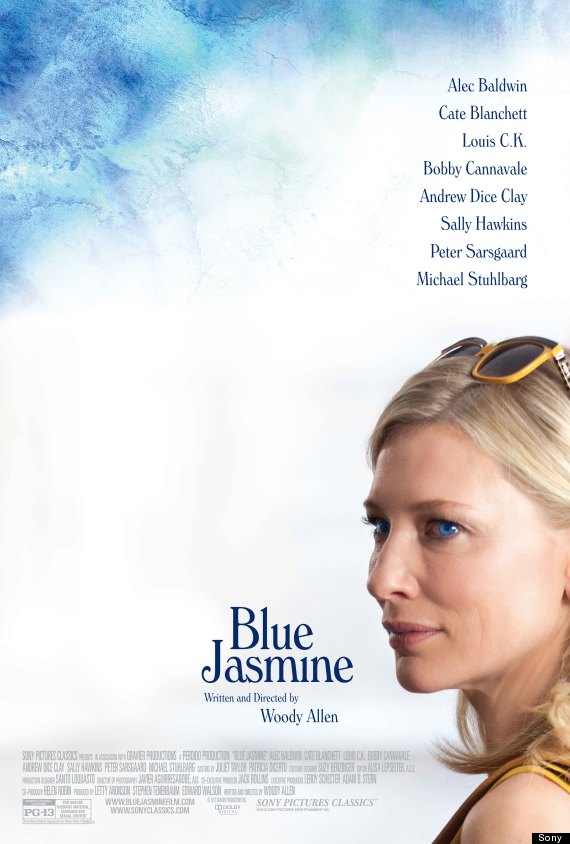


Rated PG-13 for mature thematic material, language and sexual content
Cast: Cate Blanchett, Alec Baldwin, Sally Hawkins, Andrew Dice Clay, Bobby Cannavale, Peter Sarsgaard, Michael Stuhlbarg, and Louis C.K.
Written and Directed By: Woody Allen
RICHES TO RAGS
Review By Andrew Shuster
Woody Allen’s new dramedy Blue Jasmine is an astute dramatic character study, a timely commentary on a ‘Madoff’ inspired crook, as well as a ‘clash of the cultures’ comedy. Both funny and tragic, Allen has once again opened the curtain in revealing the most intimate moments of people of various walks of life. The acting is great and the writing is strong. While there are some minor issues in pacing and the film won’t be converting any non-fans, admirers of the writer/director should be more than pleased with his new outing.
Elegant New York socialite Jasmine (Cate Blanchett) is living the high-life with her husband Hal (Alec Baldwin), an incredibly wealthy businessman. Jasmine’s life falls to pieces after Hal is convicted of a ‘ponzi-esque’ scheme and all of the couple’s assets are seized. With nowhere else to go, Jasmine moves into her sister Ginger’s (Sally Hawkins) modest apartment in San Francisco and tries to pull her life back together. But Jasmine has a hard time giving up her fancy ways. She flies first-class from NYC to San Fran even though she’s bankrupt. Ginger asks “How did you fly first-class? You don’t have any money.” “I don’t know, I just did”, Jasmine replies. She also tips the taxi driver $100 for carrying her luggage. Jasmine is denial of her situation, refusing to step down from the lifestyle she has grown accustomed to. She also feels the need to keep up appearances by toting around expensive jewelry and Louis Vuitton pocketbooks which she could easily sell to get the money she so desperately needs.

The film lays out its plot by jumping back and forth between past and present. This structure doesn’t work seamlessly, as the flow and pacing of the movie are hindered at times; but it was probably the only way to tell this story. The details of Jasmine’s former life of wealth need to slowly be revealed in order to understand her behavior in the present. This method helps develop intrigue and adds to the mystery of the relationship between characters; with their dynamics making more sense as events unfold. Sequencing the film in such a way also allows for a final plot twist that changes some things we thought we knew. No spoilers, but the twist paves the way for a somewhat downbeat ending, albeit a clever one.

This film contains one of Allen’s more cynical observations of people in his pessimistic depiction of human nature. It’s hard to feel sympathy for Jasmine in her crisis as she isn’t a particularly nice person. She’s vapid and values material things over people. But, in a true testament to Blanchett’s performance, she’s so distraught over her dilemma that you can’t help but feel sorry for her anyway. Just about every male character is a either a liar, a cheater, or an idiot. Bobby Cannavale and Louis C.K. both play potential suitors of Hawkins’ character. Cannavale gives one of the funnier performances in the movie as a dopey underachiever. He means well, but is perhaps a bit too candid when divulging into the details of Jasmine’s crisis. Disappointingly, Louis C.K. only has about five minutes of screen time. As a big fan of C.K.’s standup and his FX show Louie, the prospect of him appearing in a Woody Allen film was an exciting one. Unfortunately, we only get a slight idea of what an Allen/C.K. collaboration might look like. While his character is probably the closest anyone gets to playing ‘Woody’ in the film, his extended cameo as an unassuming gentleman turned sexual deviant is somewhat a waste.

Blue Jasmine has a lot on its mind, with Woody Allen conveying a myriad of interesting and timely ideas. While it’s certainly more of a drama than a comedy, the first half of the film is consistently humorous until it enters darker territory towards the end. The film is worth seeing for the performances alone, but Allen’s screenplay is also full of clever plot points. While there are a few spots where the film drags, for the most part it’s engaging. It certainly isn’t among Allen’s best films, but it is one of his more thought-provoking discourses in recent years.

No comments:
Post a Comment