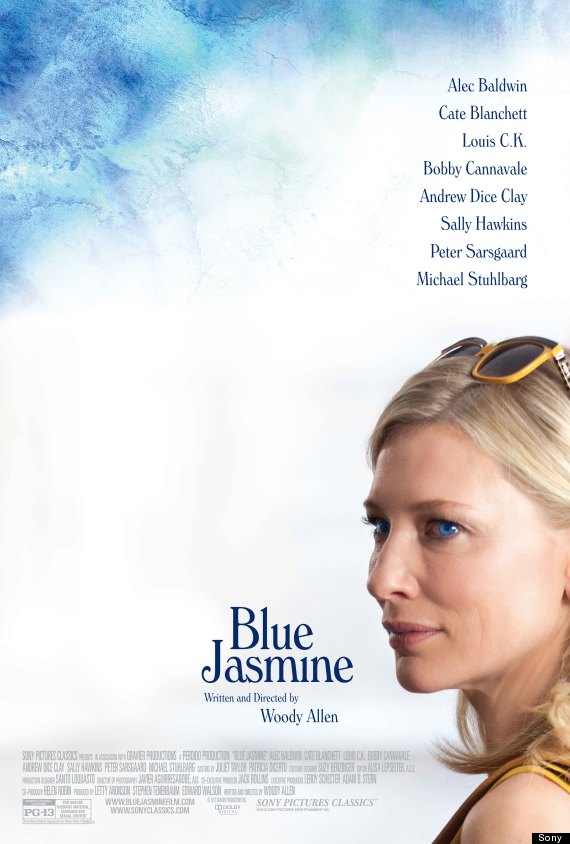
Rated PG-13 for mature thematic material, language and sexual content
Cast: Cate Blanchett, Alec Baldwin, Sally Hawkins, Andrew Dice Clay, Bobby Cannavale, Peter Sarsgaard, Michael Stuhlbarg, and Louis C.K.
Written and Directed By: Woody Allen
RICHES TO RAGS
Review By Andrew Shuster
Woody Allen’s new dramedy Blue Jasmine is an astute dramatic character study, a timely commentary on a ‘Madoff’ inspired crook, as well as a ‘clash of the cultures’ comedy. Both funny and tragic, Allen has once again opened the curtain in revealing the most intimate moments of people of various walks of life. The acting is great and the writing is strong. While there are some minor issues in pacing and the film won’t be converting any non-fans, admirers of the writer/director should be more than pleased with his new outing.
Elegant New York socialite Jasmine (Cate Blanchett) is living the high-life with her husband Hal (Alec Baldwin), an incredibly wealthy businessman. Jasmine’s life falls to pieces after Hal is convicted of a ‘ponzi-esque’ scheme and all of the couple’s assets are seized. With nowhere else to go, Jasmine moves into her sister Ginger’s (Sally Hawkins) modest apartment in San Francisco and tries to pull her life back together. But Jasmine has a hard time giving up her fancy ways. She flies first-class from NYC to San Fran even though she’s bankrupt. Ginger asks “How did you fly first-class? You don’t have any money.” “I don’t know, I just did”, Jasmine replies. She also tips the taxi driver $100 for carrying her luggage. Jasmine is denial of her situation, refusing to step down from the lifestyle she has grown accustomed to. She also feels the need to keep up appearances by toting around expensive jewelry and Louis Vuitton pocketbooks which she could easily sell to get the money she so desperately needs.

Meanwhile, Ginger’s ex-husband Augie (Andrew Dice Clay), is bitter and holds a major grudge against Jasmine over Hal losing the $200,000 Augie had won in a lottery game. The largest amount of money Augie had ever seen in his life, he planned to use his fortune to start his own business until the manipulative Hal convinced him to invest it. A humorous scene shows the blue-collar Augie interacting with Hal, Jasmine and their upper-echelon friends. Neither Augie nor Ginger (who is adopted and not Jasmine’s biological sister) belong in this world; they’re too genuine.
The film lays out its plot by jumping back and forth between past and present. This structure doesn’t work seamlessly, as the flow and pacing of the movie are hindered at times; but it was probably the only way to tell this story. The details of Jasmine’s former life of wealth need to slowly be revealed in order to understand her behavior in the present. This method helps develop intrigue and adds to the mystery of the relationship between characters; with their dynamics making more sense as events unfold. Sequencing the film in such a way also allows for a final plot twist that changes some things we thought we knew. No spoilers, but the twist paves the way for a somewhat downbeat ending, albeit a clever one.

The acting is fantastic across the board, as is to be expecting from a Woody Allen movie. He truly is an ‘actor’s director’ and consistently manages to bring out the best performances from his casts. Boozing and pill popping throughout, Cate Blanchett is Oscar-worthy in the title role. Many scenes feature the broken down Jasmine spaced out and babbling to herself in public. This could have come across silly in the hands of a lesser actress but Blanchett sells this material in a convincingly bleak matter. Alec Baldwin can play a white-collar or blue-collar guy with equal aplomb. He’s sleazy and charming at the same time. Sally Hawkins’ Ginger is arguably the only likable and decent character in the film, though not without her flaws. She displays her good heartedness by taking in the down on her luck Jasmine, even though Jasmine wasn’t nearly as kind to Ginger back when things were going well. It’s a true testament to one’s character to treat someone with respect even when they don’t necessarily deserve it. Hawkins is very good in the role.
This film contains one of Allen’s more cynical observations of people in his pessimistic depiction of human nature. It’s hard to feel sympathy for Jasmine in her crisis as she isn’t a particularly nice person. She’s vapid and values material things over people. But, in a true testament to Blanchett’s performance, she’s so distraught over her dilemma that you can’t help but feel sorry for her anyway. Just about every male character is a either a liar, a cheater, or an idiot. Bobby Cannavale and Louis C.K. both play potential suitors of Hawkins’ character. Cannavale gives one of the funnier performances in the movie as a dopey underachiever. He means well, but is perhaps a bit too candid when divulging into the details of Jasmine’s crisis. Disappointingly, Louis C.K. only has about five minutes of screen time. As a big fan of C.K.’s standup and his FX show Louie, the prospect of him appearing in a Woody Allen film was an exciting one. Unfortunately, we only get a slight idea of what an Allen/C.K. collaboration might look like. While his character is probably the closest anyone gets to playing ‘Woody’ in the film, his extended cameo as an unassuming gentleman turned sexual deviant is somewhat a waste.

In addition to perfectly utilizing established actors, Allen has the perceptive gift of seeing talent in ways that no one else has and knowing what to do with it. Andrew Dice Clay has acted in very few films. He’s better known as his ‘Diceman’ alter-ego, a filthy and misogynistic stand-up comic. Well, the ‘Diceman’ can act. Like C.K., the prospect of Andrew Dice Clay in a Woody Allen movie is both intriguing and strange. However, Clay’s presence isn’t as surreal or disconcerting as you might think. He actually fits in quite well playing against type, and delivers a particular strong monologue in his final scene in the film.
Blue Jasmine has a lot on its mind, with Woody Allen conveying a myriad of interesting and timely ideas. While it’s certainly more of a drama than a comedy, the first half of the film is consistently humorous until it enters darker territory towards the end. The film is worth seeing for the performances alone, but Allen’s screenplay is also full of clever plot points. While there are a few spots where the film drags, for the most part it’s engaging. It certainly isn’t among Allen’s best films, but it is one of his more thought-provoking discourses in recent years.
Rated PG-13 for sequences of intense sci-fi action and violence, some sexuality and language
Cast: Hugh Jackman, Tao Okamoto, Rila Fukushima, Hiroyuki Sanada, Svetlana Khodchenkova, Brian Tee, Will Yun Lee, and Famke Janssen
Written By: Mark Bomback and Scott Frank
Directed By: James Mangold
DECLAWED
Review By Andrew Shuster
Why can’t Hollywood make a good Wolverine movie? He’s arguably the best character of the X-Men universe, so why are his solo outings so lackluster? This new installment replaces the silliness that X-Men Origins: Wolverine suffered from with an even worse offense... boredom. What you get in The Wolverine is an uninteresting dramatic character study of a tortured soul that just so happens to be interspersed in between a couple of adequate action sequences. The storyline is dour, dull, and dumb all at once. The self-seriousness of a superhero movie like The Dark Knight works because that film is immersed in realism. The Wolverine features mutants, robots, and immortality. Those aspects should create fun, not despair.
The Wolverine starts off promisingly enough, with a flashback to Nagasaki, Japan in 1945, featuring Logan a.k.a. Wolverine (Hugh Jackman) rescuing a young soldier from an atomic bomb. Yes, Wolverine figures out a way to save himself and a soldier from an atomic blast. In present time, he’s hiding out in a small town somewhere in Canada when he is approached by Yuki (Rila Fukushima), a young Japanese woman with psychic abilities. She informs Logan that her employer Yashida (Haruhiko Yamanouchi), a former friend of his, is dying. Yashida's last wish is to say farewell to his long lost friend, but obviously he has a hidden agenda.

The majority of the film takes place in Japan which gives the film a fish-out-of-water vibe, but unfortunately the filmmakers don’t take the opportunity to alleviate the drama with some culture clash humor. Instead, ‘Loganson’ learns the way of Samurai in a trite plot tactic that’s painfully overused, going all the way back to the original Karate Kid. Apparently it’s improper to hold a samurai sword with one hand. You have to use two. Who knew?
The filmmaker’s throw in two unnecessary romantic subplots, the first of which features Logan’s relationship with Jean Grey (Famke Jannsen) via night terrors. This one isn’t so egregious, but the second one with Mariko (Tao Okamoto), Yashida’s granddaughter (and ‘damsel in distress’), accounts for the most tedious portions of the film. When Wolverine isn’t clawing away, the film is slow, meandering, and a borderline endurance test.

This is Hugh Jackman’s fifth outing as Wolverine, a role which he can do in his sleep and sometimes it feels like he is. No longer the wise cracking smart-ass from the previous X-Men installments, here he’s a total bummer. He’s not fun to be around and either is the movie. The film is also surprising low on action sequences with only two that really stand out. James Mangold (Walk the Line, 3:10 to Yuma) is a fine director and the film is well-made on a technical level; much more so than Origins. However, there’s only one great scene (at least there’s one), and it only lasts for about two minutes. It consists of an exciting fight on top of a speeding bullet train, with Wolverine and his opponent navigating their rooftop exploits through jumps and ducks as to not be crushed by the oncoming overhangs and tunnels. The adeptness of this scene is all the more frustrating as nothing else in the movie comes close to it. Wolverine has some ‘claw fights’ throughout, with various sword wielding enemies (including ninjas), but you’ve seen this before in previous installments and you’ve seen it done better.
For a film that’s attempting a different structure than your run-of-the-mill superhero movie, the last act falls into the same trap of a CGI’d infused finale. Wolverine battles a giant robot made out of adamantium, the same metal that Wolverine’s indestructible (or are they?) claws consist of. It’s a rather underwhelming battle and the type of scene that would occur halfway through an Iron Man movie, as opposed to a blockbusters ‘holy smokes!’ finale. Aside from the alloyed android, there’s no clear antagonist in the film. Arguably it’s Viper (Svetlana Khodchenkova) (the only other mutant in the movie), a ‘lizard lady’ who wouldn’t make the top ten list of villains among the superior X-Men films.

Aside from a couple of entertaining fight scenes, The Wolverine is a major disappointment, as I am in fact a fan of the X-Men series. With so many various mutants and their individual superpowers, there’s a fun dynamic employed when they all team up. These Wolverine solo outings don’t work. Perhaps he’s better suited when working with an ensemble. Or perhaps this movie just needed a better screenplay. Some of you may prefer the darker approach that this film takes, but it isn’t done well. Unless a comic book adaptation earns its tone by staying true to the world in which it’s set up; a superhero movie is better off having fun with what is inherently a goofy premise. The Wolverine is a downer. However, an end credits stinger (which I won’t ruin) sets up next summer’s X-Men: Days of Future Past, and has still managed to rouse my interest in the next installment despite the mediocrity of this spinoff. Hopefully when Wolverine reunites with the rest of the gang, they’ll cheer him up.
Rated R for strong bloody violence including grisly images, sexual content and language
Cast: Ryan Gosling, Kristin Scott Thomas, Vithaya Pansringarm, Yayaying Rhatha Phongam, Gordon Brown, and Tom Burke
Written and Directed By: Nicolas Winding Refn
AND YOU WILL KNOW MY NAME IS THE LORD WHEN I LAY MY VENGEANCE UPON THEE
Review By Andrew Shuster
Style over substance isn’t always a bad thing. In Only God Forgives, the style is surrealism and the substance is shocking brutality. Mainstream audiences will hate this film. As the end credits roll, they’ll most likely ask “What the hell did I just watch?” They wouldn’t necessarily be wrong. I’m not entirely sure what I’ve just watched either, but I liked it. Only God Forgives is like a waking dream (or nightmare) about immorality, that takes the viewer into an ugly criminal underworld in Bangkok, with nary a decent human being in sight. Writer/director Nicolas Winding Refn reunites with his Drive star Ryan Gosling, only this film makes the artsy/noir-ish Drive look like a conventional crime thriller.
Gosling plays Julian, the manager of a Thai boxing club that serves as the front for a drug smuggling operation. His brother Billy (Tom Burke) murders an underage prostitute, and is in turn murdered by the prostitute's father. The hit on Billy is sanctioned by Bangkok police chief Chang, (Vithaya Pansringarm) a ruthless ‘lawman’ with a very severe idea of what justice is. He also chops off the father’s hand as punishment for allowing his daughter to become a street walker. Julian and Billy’s mother Crystal, (Kristin Scott Thomas) arrives in Bangkok to collect her firstborn son’s body, but more importantly to exact revenge on his killers. She dispatches Julian to do this, but his conscience won’t allow him to feel the same sense of vengeance as his mother. He tells her, “Billy raped and murdered a sixteen-year-old girl.” “I’m sure he had his reasons”, she responds. There’s nothing like a mother’s unconditional love.

If the synopsis sounds like the movie is a straightforward revenge thriller, it most certainly is not. Refn is more concerned about the way his movie looks than he is the story. It’s shot beautifully, with each frame using a different color palette (mostly neon red lights), and you could take almost any random screenshot from the film and hang it on your wall as a piece of art. We get long shots of Gosling walking and broodingly staring into space; having very little dialogue and conveying ambiguous emotion. In fact, Gosling as leading man only has a handful of dialogue throughout the entirety of the film. His performance is stoic and reserved, and we never get a true sense of who this man is or what he stands for. He’s somewhat an anti-hero, not quite a bad guy but not such a good guy either. Gosling’s character isn’t so different than the stuntman he played in Drive, but again, he’s even more removed from reality; as is the film.
Kristin Scott Thomas gives the most flashy and campy performance in the film as Crystal, the mom from hell. She’s vulgar, evil, and there’s a certain Freudian relationship between her and Gosling. She’s as ruthless, if not more so, as antagonist Chang. Pansringarm’s performance as Chang is also one of the highlights of the film. He puts forth an almost unbearable level of sadism and eeriness. His interrogation of one of Crystal’s henchman features him gouging out the man’s eyes and plunging a large sewing needle through his ear canal. It’s one of the most shocking displays of brutality in recent memory.

You’ll need a strong stomach to sit through most of this. The violence is as graphic as it gets, with decapitations, amputations, throat slitting, and severe beatings courtesy of baseball bats, frying pans, and fists. Chang uses a samauri sword as his means of exacting discipline, and every time he takes that weapon out, you quiver in anticipation of the inevitable savagery you’re about to witness.
For a film that consists of fistfights and shootouts, this isn’t quite an action movie. This is an arthouse film disguised as an action thriller. It’s slow moving, with careful attention to detail and an overall subdued pace. Above all, Only God Forgives is weird. It brings to mind the films of David Lynch and Jim Jarmusch; films about criminal activity, but only on a surface level. Although, what occurs in this film is perhaps more pseudo-intellectual than deep and metaphorical. The meaning of it all can be discussed and analyzed, with no right or wrong answer as to its intentions. In that regard, the film is somewhat of a stylishly experimental and empty mess. However, it’s never less than engaging.

If ever the words ‘this film isn’t for everybody’ held more credence, it’s in describing Only God Forgives. Interminably artsy and grossly inhumane, the film is disconcerting and ‘only God knows’ who the audience for this movie is. It follows the arthouse formula of an ambiguous ending; but come to think of it the beginning and middle are ambiguous as well. This isn’t a pleasant film. It’s rather cynical and pessimistic in its view of the world we live in. However, Only God Forgives is interesting, different, good, bad, dull and entertaining all at once. I can’t quite say I enjoyed it, but I sure did like it.
Rated R for sequences of disturbing violence and terror
Cast: Vera Farmiga, Patrick Wilson, Lili Taylor, Ron Livinston, Shanley Caswell, Hayley McFarland, Joey King, Mackenzie Foy, Kyla Deaver, Shannon Kook, and John Brotherton
Written By: Chad Hayes and Carey Hayes
Directed By: James Wan
EXORCISM 101
Review By Andrew Shuster
Halfway through The Conjuring I thought, “Well, I’ll be keeping the lights on when I go to sleep tonight.” This is old-school horror with little in the way of gore but a lot in the way of scares. There are some truly terrifying moments in this film. It’s a refreshing throwback to retrograde haunted house movies, relying on genuine scares as opposed to cheap thrills. The film is both well acted and skillfully directed, but more importantly, The Conjuring is one of the scariest movies in years.
The Conjuring is a prequel of sorts to The Amityville Horror, both films being based on real-life paranormal investigators Ed and Lorraine Warren (Patrick Wilson, Vera Farmiga). While the film claims to be ‘based on the true story’, it’s doubtful that most of the events which occur in the film realistically happened. Skeptics even believe that both the Amityville story and the story presented in this film (based on the accounts of the Perron family) are hoaxes. All the same, the fact that there really was an Ed and Lorraine Warren, a Perron family, and that this story manifested from somewhere, makes it all the more eerie.

The film opens with a clever and somewhat humorous prologue introducing us to the Warrens. They are listening to the account of two young nurses who believe the ghost of a young girl has possessed the body of a doll in their apartment. “Ghosts can’t inhabit objects” explain the Warrens, “That’s a demonic force”. The Warrens also teach a class on demonology at a local university and keep possessed mementos from their past cases in their home. At first, we get the idea that the Warrens may be kooks or even swindlers. But it becomes all too apparent that they're the real deal when they later arrive at the Perron’s haunted home.
Meanwhile, Carolyn and Roger Perron (Lili Taylor, Ron Livingston) move into an old farmhouse in Rhode Island with their five daughters ranging in ages from about seven to sixteen. The production design is stellar, as this house is creepy before any of the ghostly activity even occurs. Soon after moving in, things start going bump in the night. Doors and windows slam open and shut, rotten smells brew from nowhere, Carolyn wakes up with unexplained bruises on her body, and for some reason all of the clocks in the house stop at 3:07 AM every evening. Like most horror films, it begins with a slow-burn, and there could possibly be an explanation for all this. We know better. The menacing conditions rapidly intensify to the point where there’s no other explanation but a ghostly infestation.

The film uses an ingenious plot device to set up a series of frightening sequences by implementing a made up game called ‘hide and clap’. The young girls play this game by blindfolding one of the sisters while the other siblings hide in various areas of the home. The blindfolded girl then calls out for them to clap, with the goal to find them by following the sound. Think ‘Marco Polo’ on land. Turns out evil spirits like to play this game too. You’d never think a pair of clapping hands could be so chilling; but the film sets up and executes this scene perfectly, and its one of the most clever and unnerving horror set-pieces in ages.
While there are definitely some horror movie cliches that the film succumbs to, for the most part it avoids this trap; if only for the fact that the acting and writing are much stronger than is typical from this fare. Wilson and Farmiga are likable as the Warrens, with Farmiga giving a very strong performance as a woman shaken from her profession but attempting to keep it together. Taylor, as the Perron’s matriarch, is believable in her need to protect her family; with her and Farmiga getting some good scenes together bonding as mothers. Mothers dealing with ghosts who are threatening their children. What’s nice about the Perron family and especially the performances to sell this material is how loving they are to each other. Because of this, it’s more daunting and the audience becomes invested when evil threatens their foundation. The Perron daughters are all quite effective young actresses; interminably precious, frightened, and sometimes creepy. One of the sisters develops a sleepwalking habit. The youngest daughter appears to have made a friend who isn’t there. “Who are you talking to?” her mother asks. Playing with an antique jack-in-the-box with a mirror attached, the girl tells her mom, “Wind it up, and when the music stops, you’ll see him in the mirror standing behind you.”

James Wan, who directed the decent but overrated Saw and the dreadful Insidious, has inexplicably learned how to direct a movie. It’s almost as if he decided to remake Insidious, only make it good this time. He even recasts lead actor Patrick Wilson. Wan nimbly uses acrobatic camera movements and strange angles to amp up the tension and excitement. The musical score and sound effects are also utilized to full effect, adding to the overall feeling of dread. As previously mentioned, Wan can’t help but engage in some overused elements of horror; but there’s only so much innovation one can come up with for a haunted house movie. The cinematography consists of muted grayish/blue colors that add to the retro feel, (the movie is set in 1973) and makes for a classy looking production. The 70’s setting, being devoid of modern technology, serves in the discomfort of it all.
At times, the film feels like a horror genre hybrid, with echoes of The Exorcist, Poltergeist, and obviously The Amityville Horror. For the first 2/3 of the film, the scare scenes are somewhat restrained and its during this period that the most jolting moments occur. The last act goes all out in lunacy and even silliness, but at that point the film has earned it. There’s a whole lot happening at once in this sequence; in addition to the demonic possession we get pigeons soaring through windows. It feels like you’re watching a heightened contemporary remake of Alfred Hitchcock’s The Birds.
The Conjuring is a scary movie. Plain and simple. That’s all you can really ask of a horror movie, but the film provides an added bonus of being generally smart and well-made. Prepare for a beating heart and white knuckles. It isn’t the most original or innovative example of the genre, but you’ll be too terrified to notice.

Rated PG-13 for sequences of intense sci-fi action and violence throughout, and brief language
Cast: Charlie Hunnam, Idris Elba, Charlie Day, Rinko Kikuchi, Robert Kazinsky, Max Martini, Clifton Collins Jr., Burn Gorman, and Ron Perlman
Written By: Guillermo del Toro and Travis Beachman
Directed By: Guillermo del Toro
ROCK 'EM, SOCK 'EM ROBOTS
Review By Andrew Shuster
Ow. My brain hurts. Pacific Rim is sensory overload featuring two hours of rock ‘em, sock ‘em robots, rocking and socking Godzilla-sized monsters. While the visual effects are among the best of all time, the story and characters are fairly thin. Undeniably, there are numerous “Whoa! That was cool!” moments throughout the film, but by the end it all becomes a bit too much. Fans of subtlety should look elsewhere. Pacific Rim is for a particular kind of action movie audience, and if you like this sort of thing, you’re going to like this thing. Those who prefer more practical effects featuring car chases, shootouts, and humanoids doing the hand-to-hand combat as opposed to androids, you’ll probably grow weary.

The film only takes place about ten years into the future. By then, legions of giant, monstrous sea creatures going by the name Kaiju have invaded our world to wipe out humanity. In order to defeat this enemy, the government built massive robots called Jaegers. The Jaegers are controlled by two pilots, with each pilot getting one half of the body of the machine. The co-pilots minds are then neurologically linked so they can fight in synchronization. Washed up former pilot and loose cannon Raleigh Becket (Charlie Hunnam) is teamed up with rookie Mako Mori (Rinko Kikuchi), a woman whose emotions may get the better of her as a result of watching her father killed by the Kaiju when she was a child. Employing them is the leader of this outfit, Stacker Pentecost, (Idris Elba) a tough-as-nails former pilot. Raleigh and Mako must defeat the biggest threat to humanity yet, a ‘level 5’ Kaiju, which we are to understand is a very high level; and thus very bad.
The preceding paragraph is the A-story and contains the majority of the spectacle. There is also a B-story and this subplot happens to be way more interesting. Here, scientist Newton Geiszler (Charlie Day) has discovered a way to neurologically link brains (which is called ‘drifiting’) with the Kaiju in order to see their memories, and hopefully discover their motivations and weaknesses. In order to obtain a Kaiju brain, he has to find Hannibal Chau, (Ron Perlman) a shady black-market dealer of Kaiju body parts. Day, of TV’s It’s Always Sunny in Philadelphia and the hit comedy Horrible Bosses, provides most of the comedic relief. Day is a very funny performer but his typical forte and strength is in playing wound-up, borderline mentally disturbed characters. Here, he’s more quirky than irreverent. However, the scenes with Day and Perlman are among the best of the film. Can we get a buddy comedy starring these two? Perlman’s role is small, but a definite highlight; he plays a sleaze-bag all too well.

While I found the B-plot more engaging, the epic-ness and spectacularity of this production (and the reason people are buying a ticket) mostly occurs during the A-plot. The visual effects are as impressive as it gets and you’ll be in wonderment over what is possible with the magic of CGI these days. There’s a show stopping scene halfway through the film featuring a Jaeger beating a Kaiju over the head with a cargo ship. Awesome is the only word to describe that. However, the middle portion of the film also drags quite a bit, and at one point I said to myself, “I haven’t seen a monster or robot in about 30 minutes.” It’s during this section that character development is attempted, with some flashbacks via ‘drifting’ showing us the baggage of the protagonists pasts. It’s admirable to attempt a human story considering the material, but honestly... just give me robots vs. monsters and cut down the two-hour plus runtime.
Director Guillermo Del Toro (Pan’s Labyrinth, Hellboy) is clearly giddy over this material and his enthusiasm shows. Del Toro is among the kings of the fanboys/geeks whom eat up this sort of thing. The film is heavily influenced by monster movies such as Mothra vs. Godzilla, as well as Japanese anime and manga comic books. In full discretion, that ain’t my thing, so take that for what it’s worth. Then there’s the obvious similarities to Transformers; they even throw in a bit of Top Gun for good measure, with an adversarial dynamic between the team of pilots. Del Toro is a gifted director. The film is both visually stunning and the action executed well. The final thirty minutes keeps with the action movie formula of a last act consisting of non-stop mayhem. By that point, I was kind of over it. It’s incredibly impressive to watch but not terribly exciting.

Pacific Rim is mostly style over substance. It’s interminably entertaining; at times awesome and other times boring. This is a very genre specific film and chances are you already know if you’re in or out based on the trailers. The film is very energetic and a lot of care was put into the production, but it doesn’t help it from feeling like a live-action cartoon at times. Or worse yet, watching somebody else play a video game. If you have the chance to see this in IMAX 3D, that’s the way to do it. The immersive experience and scope of that giant screen makes the creatures and robots seem life-sized and right on top of you. Watching this movie on an iPad will not be nearly as enjoyable. Pacific Rim is faithful and competent in regard to its specific genre. But this sort of thing just ain’t my bag.
Rated PG-13 for crude and suggestive content, language and some male rear nudity
Cast: Adam Sandler, Chris Rock, Kevin James, David Spade, Salma Hayek, Maya Rudolph, Maria Bello, Nick Swardson, Taylor Lautner, Colin Quinn, Tim Meadows, with Steve Buscemi and Shaquille O'Neal
Written By: Adam Sandler, Fred Wolf,
and Tim Herlihy
Directed By: Dennis Dugan
MEN WILL BE BOYS
Review By Andrew Shuster
At risk of losing all critical credibility, I must admit that I am an unapologetic fan of Adam Sandler. His first forays into filmdom, Billy Madison & Happy Gilmore, are two of the funniest, weirdest, craziest, and irreverent comedies ever made. But if those two movies are like punk rock than Grown Ups 2 is folk music. This film meanders from one lame comedic set-piece to another, devoid of any sense of plot or structure. That wouldn’t be such a problem if any of it were funny. It rarely is. It’s disheartening to see someone who was once a comedy all-star put out a film so lazy and uninspired. Adam Sandler is undoubtedly a smart and funny guy; deep down he has to know that this isn’t very good. Even more so than Grown Ups 2 insults the audience’s intelligence, Sandler insults his fans with the fact that he no longer cares.
The story (and I use that term lightly) sees former Hollywood agent Lenny Feder (Sandler) returning to his small hometown to raise his family. Also in town with their respective families are Kurt McKenzie (Chris Rock) and Eric Lamonsoff (Kevin James). The still single Marcus Higgins (David Spade) visits and learns that he is the father of a teenage son, (Alexander Ludwig) a psychopath who is violently angry with his absentee dad. Inexplicably missing is Rob Schneider whose disappearance is never explained as if he didn’t exist in the first movie at all. It’s unclear why Schneider got cut from the sequel, but seeing as Sandler appears to be his only employer these days, it’s hard to imagine it was due to a scheduling conflict.

The entire film takes place on the last day of school before summer break. With so many families involved, almost each kid gets their own subplot, taking screen-time away from the established comedians. Lenny’s son Greg (Jake Goldberg) has a crush on a girl at school who is way out of his league and he’s intimidated to ask her out. Lenny gives some fatherly advice, “You’re fugly. But all the men in our family are fugly, it doesn’t stop us from getting women.” His other son Keith (Cameron Boyce) is dealing with a school bully, and Feder tries to get him to stand up for himself, but it turns out the apple doesn’t fall far from the tree. Feder is still scared of his former school bully Tommy Cavanaugh (‘Stone Cold’ Steve Austin) who has reappeared to torment him in adulthood. Meanwhile, Higgins and his new son have to work out their issues. James’ and Rock’s characters kids have subplots as well but it’s irrelevant to even mention them as their so insignificant and abruptly resolved, if at all. In fact, most of the character’s storylines go absolutely nowhere; with flickers of plot points being brought up then never seen again.
Many moments throughout this film don’t even feel like an Adam Sandler movie as much as they do a bland children’s sitcom on the Disney Channel or a subpar Wayan’s Brothers’ movie. The jokes are aggressively stupid, as if Sandler and his writers sat around asking themselves, “How can we make this dumber?” Worse is the execution of many of the jokes which just felt oddly off. If timing is everything in comedy then the filmmakers watches must have been defective.

There are so many funny and talented performers in this movie including a large assembly of Saturday Night Live alumni, with appearances by Tim Meadows, Colin Quinn, Andy Samberg, and Jon Lovitz; among others. But they barely get anything funny to say or do. One scene in particular featuring Jon Lovitz as a pervy janitor of a women’s fitness class feels like a random SNL sketch dropped into the middle of the movie. Again, the fickleness of this scene wouldn’t be a problem if any of it were funny. It is not. Nick Swardson, who’s a regular Sandler supporting player and can be very funny, plays one of the weirdest and least funny characters of any comedy in recent memory. He’s a whacked out, drug-addled school bus driver. Sounds funny on paper. It is not. And you know a movie is in trouble when Shaquille O’Neal gives a funnier performance than Chris Rock. O’Neal, being a behemoth of a man, gets some funny sight gags including him sleeping in a child’s playhouse. That’s kind of funny. Kind of funny. There are a handful of chuckles and decent one-liners but there isn’t one big belly laugh in the entire movie.
The scatological driven humor reaches levels of unbelievability, with most jokes featuring piss, farts, and projectile vomiting. One joke that keeps getting a callback is that Kevin James’ character has perfected the sneeze/burp/fart in which he can do all three at the same time. This joke isn’t done once; it’s a running gag throughout the movie. The jokes that aren’t about bodily functions use a tired formula of applying a metaphor to describe someone’s physical appearance. One of the character’s calls Chris Rock ‘skinny Danny Glover’. After a vain fraternity guy played by Taylor Lautner insults Sandler, he retorts, “Easy there Abercrombie.”

Seeing Sandler’s usual suspects (such as Peter Dante & Allen Covert) is usually one of the joys of visiting Happy Madison land. Here, their appearances just feel arbitrarily thrown in and they aren’t funny. At no time does any of this feel sincere or like you’re not watching a movie as not one character emulates the behavior of anyone in real life. At one point Sandler says “We’re irrelevant, we’re losers, we’re old.” Is he admitting something or is the irony lost on him? Comparing this to last months This is the End, (the best comedy of the year) starring the younger generation of comedians like Seth Rogen and Jonah Hill, makes Grown Ups 2 all the more embarrassing. Rogen played Sandler’s comedy protégé in the movie Funny People. The student has become the teacher.
Of all the movies Sandler could have chosen to sequelize, Grown Ups is one of the most unappealing. How about Bigger Daddy? You Still Don’t Mess with the Zohan? Happier Gilmore? Or better yet an original idea? Seeing as the original Grown Ups was his biggest box office hit, (raking in over $270 million worldwide) the reason for the sequel is apparent; but it also makes it hard to defend him against accusations of being a sellout. While it’s becoming more questionable, it’s still possible that Sandler has another great comedy left in him. But at 46 years old, Sandler has made his most juvenile movie yet with Grown Ups 2. If this is growing up, he needs to regress.
Rated PG-13 for sequences of intense action and violence, and some suggestive material
Cast: Johnny Depp, Armie Hammer, William Fichtner, Barry Pepper, Helena Bonham Carter, Ruth Wilson, James Badge Dale, and Tom Wilkinson
Written By: Ted Elliot, Terry Rossio, and Justin Haythe
Directed By: Gore Verbinski
Hi-Yo Silver!
Review By Andrew Shuster
The Lone Ranger is one of the oddest summer blockbusters in a long time. It’s old-fashioned, yet modern. It’s wacky and lighthearted but also has to be the most violent Disney movie ever made. And for a movie called The Lone Ranger, the real star of the movie is the Native American ‘sidekick’ Tonto, as played by Johnny Depp. The movie should probably be called Tonto. When was the last time the top-billed actor didn’t play the character in the title role? There’s a whole lot going on in this movie and it never really settles on a consistent tone. At the same time, it’s absurdly entertaining. Even if The Lone Ranger is somewhat of a mess, in a way that only adds to the enjoyment of it.
The film takes the Never Ending Story/Princess Bride approach to storytelling with a young boy in present time (the present here being 1933) being told tale of the adventures of The Lone Ranger and Tonto. A geriatric Tonto narrates for young Will (Mason Elston Cook), a Lone Ranger enthusiast, how lawman John Reid (Armie Hammer) became the legend of justice. Like all good stories, you get the idea that Tonto may be embellishing things a bit, or flat out confusing details due to his old age. At one point, a bag of peanuts which the boy is eating in present time makes its way into the legend of yore, hinting that Tonto may be muddling the past and present.

As it goes, John Reid, a law student and aspiring Texas Ranger, lives in the shadow of his heroic older brother Dan (James Badge Dale). When Dan and his team of Rangers are wiped out by Butch Cavendish (William Fichtner) and his posse of ruthless outlaws, John is left alone to seek justice, thus becoming The Lone Ranger. Dan’s widowed wife Rebecca (Ruth Wilson) and her young son Danny (Bryant Prince) are kidnapped by Butch and the boys, paving the way for Reid to come to their rescue. Meanwhile, millionaire business tycoon Cole (Tom Wilkinson) is planning a massive construction of a railroad across America which would lay waste and ravage through Indian Reservations. This does not make Tonto very happy. The Lone Ranger and Tonto team up to defeat the respective bad guys from carrying out their devious plans.
Johnny Depp has played more quirky roles than any other movie star in history. You could fill up a giant Halloween bash with the partygoers dressed as his characters. While Tonto doesn’t have the exuberance of Jack Sparrow, there’s a reserved but similar way about him and he could be Jack’s Cherokee cousin. Depp’s Tonto is almost like Bugs Bunny at times, especially in the wild train sequences where he briskly makes his way under and around the locomotive, very much in the manner of a cartoon character. It should be mentioned though that amongst these cartoonish hijinks, the same scene features a tribe of Indians being slaughtered by machine gun fire. This is one of the more glaringly disconcerting examples of the aforementioned tonal inconsistencies. The film jumps from buddy-comedy antics between the mismatched and bickering Lone Ranger and Tonto, to scenes of violent sadism at the hands of the menacing Butch Cavendish. I must admit, while it felt odd, I didn’t have such a problem with the shifts in tone. A movie should probably decide what it wants to be and stick with it, but again, there’s something about the messiness of this movie that I found endearing.

Armie Hammer’s Lone Ranger is a more bumbling, borderline idiotic hero than you might expect from a summer blockbuster. This isn’t the brooding Bruce Wayne or the stoic Clark Kent. John Reid is kind of an unappreciated screwup, that is until he must put on the mask and save the day. Throughout their journey, Tonto plays mischievous tricks on him whilst ‘teaching’ John about Indian culture. Tonto steals a drink from John and tells him that it’s an Indian gesture of respect to taste another man’s drink. When John later steals a drink from the Indian Chief it does not go over too well. Armie Hammer (an heir to the Arm & Hammer baking soda empire) is energetic in his role. But this is Depp’s show, and the majority of people buying a ticket to see The Lone Ranger are most likely going for Tonto.
The biggest flaw with the film is its bloated running time which causes it to noticeably drag in many spots throughout the second act. At 149 minutes, the filmmakers are obviously going for an epic scale ‘bigger is better’ approach, but it’s wholly unnecessary. Part of the problem is the need to add an origin story to Tonto with flashbacks and fellow tribe members explaining how Tonto came to be who he is. When we first meet Tonto we just assume that all members of the tribe act in his outlandish manner. When we meet the more levelheaded members, it becomes apparent that Tonto is somewhat mentally unstable. There’s a whole lot going on plot-wise as scenes interchange between The Lone Ranger and Tonto getting involved in various capers, Butch and the gang up to no good, Cole and other business magnates discussing railroad manufacturing plans; then there’s a subplot involving the madame of a brothel (Helena Bonham Carter) who dons a fake leg that moonlights as a pistol, and serves to further the exploits of our heroes via plot information. While the film mostly held my interest throughout, bringing the film down to a more manageable 2 hour length would do wonders for its palpable lack in pacing.

What the film will best be remembered for is featuring two of the most spectacular runaway train extravaganzas ever filmed. The opening twenty minutes sees our protagonists chained together as they must navigate their way atop a train and outrun armed outlaws. The final twenty minute battle is arguably the best action sequence of any movie this summer. It’s a seamless hybrid of CGI and practical effects featuring incredibly inventive stunt work, all perfectly set to the William Tell Overture (the theme song to the radio and TV adaptations of The Lone Ranger). The sheer amount of movie marvel going on throughout the different cars of the train as all of the heroes and villains reach their climax of the story is outstanding. The Lone Ranger rides a white stallion across the roof of the speeding train and that only scratches the surface of the craziness that occurs.
Director Gore Verbinski shows a real skill in handling this over-the-top production and perhaps the reason those train sequences are so much fun is that it’s always clear what’s happening and the action never becomes jumbled. Verbinski also helmed The Pirates of the Caribbean series, and The Lone Ranger has a lot more in common with the first Pirates movie than it does the irritating sequels. This isn’t a well disciplined movie and if someone else hated it I would totally get it. However, if you don’t always need a neat plate of symmetrically placed food and can enjoy a sloppy joe from time to time, take a bite out of The Lone Ranger.