Friday, September 13, 2013

RUSH


Rated R for sexual content, nudity, language, some disturbing images and brief drug use

Cast: Chris Hemsworth, Daniel Brühl, Alexandra Maria Lara, Christian McKay, Pierfrancesco Favino, and Olivia Wilde

Written By: Peter Morgan
Directed By: Ron Howard


NEED FOR SPEED
Review By Andrew Shuster

Rush has to be the classiest movie about racecar driving ever made. Director Ron Howard is behind the wheel (pun intended) on this one, delivering another intelligent and thrilling drama. Howard has quite an eclectic resume of films of varying genres, but it’s this type of Oscar-baiting movie that he does best. Rush isn’t from the Ron Howard who made How the Grinch Stole Christmas and The DilemmaRush is from the Ron Howard who gave us Apollo 13 and Frost/Nixon.


It helps that Peter Morgan, the screenwriter behind The Last King of ScotlandThe Queen, and Frost/Nixon, penned the screenplay. Morgan infuses elegance into the world of Formula 1 racing. Based on a true story and set in 1976, Rush is about two very different men and the rivalry that would drive them, literally, to become better men. James Hunt (Chris Hemsworth) is an English playboy and cocky ‘bad boy’ of the sport. When he’s not leaving his opponents in the dust on the track, he spends his time boozing, drugging, and bedding various stewardesses, nurses, models, or really any woman he comes into contact with. New to the game is Austrian driver Niki Lauda (Daniel Brühl), a methodical man whose entire life is dedicated to racing, leaving him with a nonexistent social life off the track. Their distinct personalities and intense rivalry captivates the world. The entire globe is white-knuckled and on the edge of their seats as to who will become the next world champion of Formula 1, and the audience will be too.

What sets Rush apart from other sports movies and is a fundamental proponent of the film’s success, is that there is no clear hero or villain here. Both Hunt and Lauda are real people, chockfull of likable attributes and grave character flaws. Hunt is the flashier of the two, bringing an excitement to the sport and using his celebrity off the track to reap life’s lascivious benefits. Lauda is headstrong, matter-of-fact, and the unequivocal underdog. We always like to root for the underdog and at times you will. But Lauda doesn’t make it easy for the audience to get behind him, as he’s cold and asocial. That is until he falls in love. He meets his future wife Marlene Knaus (Alexandra Maria Lara), with whom he shows a very different side to his personality. Lauda has a heart after all. But it turns out that the womanizing Hunt has a heart too. Now we’re conflicted. It helps if you don’t know the outcome of this true story beforehand, as the uncertainty of who wins significantly amps up the excitement of the third act.

The movie does a take a little while to find its footing, as the second half of the film is notably better than the first half. It takes some time for the crux of the story to kick in and for the characters to develop, but once these pieces come together, the movie gets quite good. It’s a bit unfortunate that the first half of the film doesn’t have the same momentum. It’s not at all bad, it’s both interesting and essential, but the second half is where this thing really takes off. Howard has orchestrated some terrifically exciting racing sequences in his depiction of Formula 1, a sport in which one wrong move could cost you your life. Lauda’s character arc reaches its apex when he does in fact experience a horrific crash, resulting in severe burns to his face and body. It’s the most harrowing scene in the film and the point where the audience finally sympathizes with Lauda. For the first time, he comes to the realization that life off the track just might be more important than his profession.

Hemsworth and Brühl both deliver fantastic performances. With his long mane, Hemsworth doesn’t look much different from the God of Thunder he’s best known for playing, but this is the best acting achievement of his career. He’s tailor-made for the role of the vain and brazen Hunt. However it’s Brühl, best known as the Nazi war hero from Inglorious Basterds, who is the standout of the film. It’s not easy to root for an a-hole, but Bruhl manages to get you on board with the inhibited and damaged Lauda. He’s genuine, yet emotionally damaged, and as an audience we begin to understand him. At one point he says, “Happiness is a weakness. It means you have something to lose.” The opposing depictions of each man’s marriage is very telling of their personalities. Hunt throws a flashy spectacle of a wedding with vapid model Suzy Miller (Olivia Wilde) whom he barely knows. He’s putting on a show. Lauda quietly elopes with his true love in a courthouse. One of the most interesting aspects of the film is how Hunt and Lauda’s opposing dispositions define them both on and off the track.

Rush is the type of sports film that transcends its material and will be enjoyed by even those who know nothing about Formula 1 racing (such as myself). It’s an emotionally gripping drama about imperfect men, their relationship with one another, and how one learns more from their enemies than they do their friends. As Hunt and Lauda came face-to-face, I couldn’t help but think of another great rivalry, that between news anchors Ron Burgandy and Wes Mantooth. To quote Anchorman, I half expected one of the drivers to say “At the bottom of my gut, with every inch of me, I plain, straight hate you. But dammit, do I respect you!” That line is a perfect summation of Hunt and Lauda’s relationship.

Ron Howard is the consummate filmmaker who’s created a movie both beautifully shot and featuring some of the most thrilling track races of any movie of this ilk. With a stronger first half, Rush could have achieved greatness. But similarly to the main characters, the movie has its flaws; yet in the end it’s both solid and respectable.

Friday, August 23, 2013

THE WORLD'S END


Rated R for pervasive language including sexual references 

Cast: Simon Pegg, Nick Frost, Paddy Considine, Martin Freeman, Eddie Marsan, Rosamund Pike, and Pierce Brosnan
Written By: Simon Pegg & Edgar Wright
Directed By: Edgar Wright


BRITISH INVASION
Review By Andrew Shuster

The “Cornetto Trilogy” ends with The World’s End, a very clever and entertaining conclusion to Edgar Wright’s series of hybrid’ genre-bending comedies. Writer/director Wright and stars Simon Pegg (also a co-writer) and Nick Frost took a bite out of Dawn of the Dead with Shaun of the Dead, a zombie comedy that had both heart and brains (metaphorically and literally). Their follow-up Hot Fuzz took a shot at buddy-cop action movies, namely Bad Boys II and Point Break. Now they abduct sci-fi thrillers such as Invasion of the Body Snatchers and The Stepford Wives. The World’s End works as both a satire for movie lovers, and an emotionally driven examination of friendship and aging. It’s perhaps not as laugh-out-loud funny as their previous entries, but it’s still a very satisfying finale.

Although these films are considered a trilogy, that isn’t entirely accurate. Instead they share a connective tissue (most evidently the cameo appearance of a Cornetto ice cream cone), and use a plot device to tell a broader story. Shaun of the Dead and Hot Fuzz focused on male bonding and friendship. The World’s End does as well, but it’s also their most mature piece of work with the added discourse on growing older and the perils of living in the past. Hot Fuzz is perhaps my favorite of the three films (although that’s debatable, these movies are pretty comparable), but it’s also probably the messiest, and The World’s End is a much more disciplined movie. However, I should mention to the fanboys who absolutely adore these movies that I think Shaun of the Dead and Hot Fuzz are solid comedies, but also slightly overrated.

Gary King (Simon Pegg) is a man-child whose glory days are behind him. Nostalgic for the past and unhappy in the present, he resolves to track down his old friends and relive the “Golden Mile”, a pub-crawl that they were unable to finish as teenagers. The mission consists of drinking a pint of beer at twelve different pubs; the final pub, which they failed to reach on their first go, is called The World’s End. Gary hasn’t changed since his days of yore, but the rest of the group has moved on to adulthood and aren’t as enthusiastic about going back to their old town for a day of binge drinking. The rest of the group consists of Peter (Eddie Marsan), Oliver (Martin Freeman), Steven (Paddy Considine), and Andrew (Nick Frost). Nevertheless, Gary convinces the crew to come along.

What starts off like a buddy-reunion comedy in the vein of Diner, The Big Chill, or even Grown Ups, turns into something entirely different when the guys realize that their old town and its inhabitants aren’t quite what they remembered, and that an extra-terrestrial force may have something to do with that. The robot-like nature of the townspeople, whom the boys refer to as “blanks” as it’s unclear what they are exactly, is reminiscent of the glowing-eyed children in The Village of the Damned. As the alien invasion films of the 50’s used to do, this genre trope is used as a commentary on society. One of the characters refers to the invasion as being similar to the infestation of Starbucks. The pubs that the boys visit have become corporatized and have lost their rundown charm.

The “blanks” also represent conformity and abiding to the rules and regulations of society. Gary’s battle against being turned into one of these sentient being is also an illustration of his fight against living a conventional lifestyle, and becoming just another slave to social order. There’s also a statement on the rise in technology, and how our attachment to cell phones and computers have made us all “programmed”, and less connected to other humans. Now don’t think any of this allegory is heavy-handed or dour. The movie is a whole lot of fun, containing consistently funny wordplay dialogue and some brilliantly choreographed action sequences. Wright has honed his directorial skills since his first feature film, with the fight scenes in this one being terrifically executed. It’s all very violent, but because the “blanks” spurt out blue goo instead of blood, their decapitations and limb ripping isn’t particularly gory or gruesome. It’s amazing how a change in color can effect perspective.


Unfortunately, while the movie is very humorous and clever, it isn’t all that gut-busting. While there is a steady stream of chuckles throughout, the movie is lacking in terms of big belly-laughs. But as a story-driven sci-fi mystery, there’s a developing sense of intrigue as events unfolds. Plot points are gradually revealed, satisfyingly answering the questions that the audience will undoubtedly have. What are the “blanks”? Are they robots? Are they aliens? How did they get that way and what did it to them? All this and more will be revealed.
The World’s End works as both a satire of sci-fi thrillers as well as a bittersweet comedy about growing up. One minor complaint would be the ending which takes a shift in tone from the rest of the film and is somewhat underwhelming. And while I’m throwing out grievances, the movie could also be funnier. However, The World’s End is smart, has something to say, and is full of ridiculously entertaining action sequences. It may not be the best end-of-the-world comedy of the year (that would be This is the End), but it’s the only one with Cornetto’s.

Wednesday, August 21, 2013

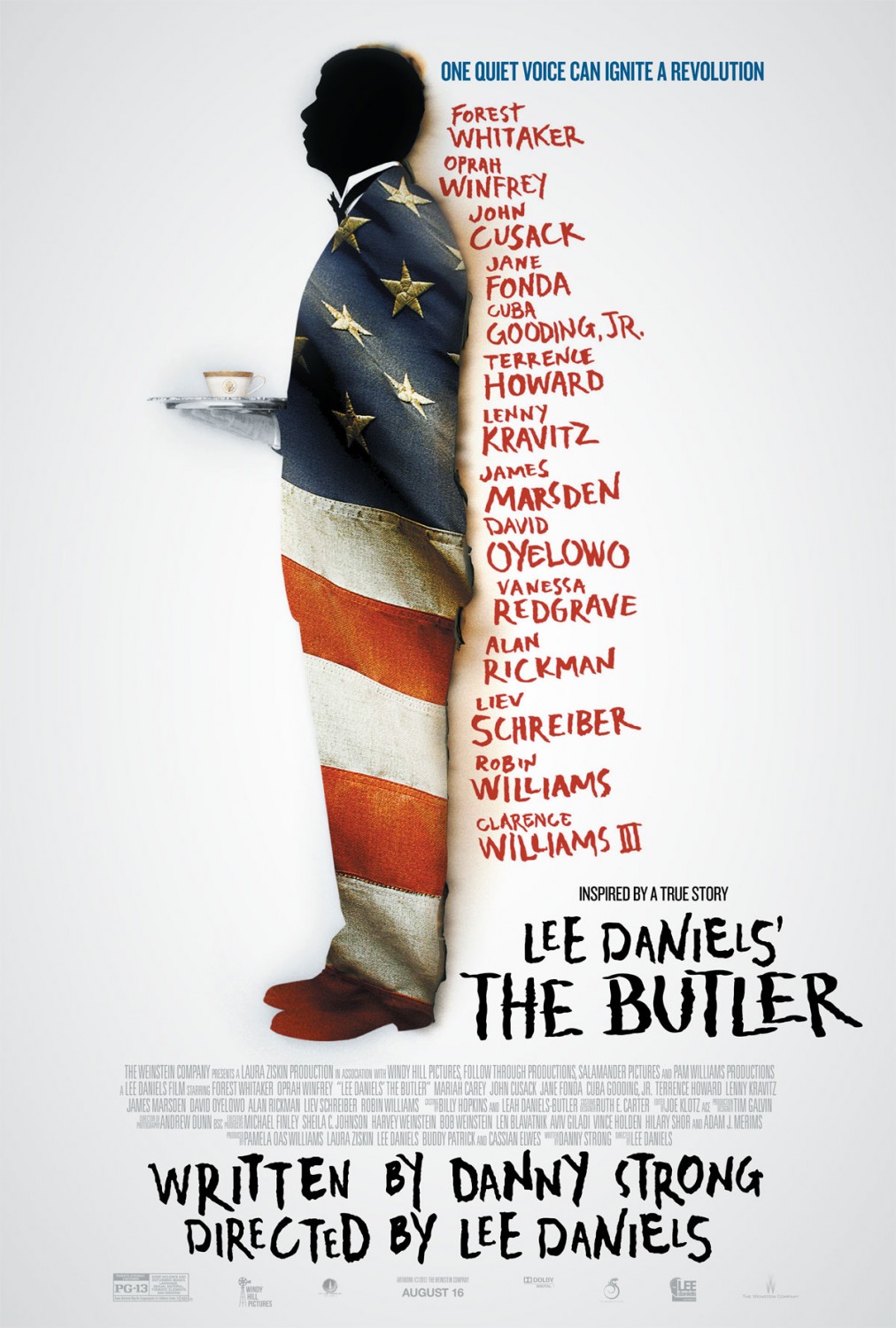
LEE DANIELS' THE BUTLER


Rated PG-13 for some violence and disturbing images, language, sexual material, thematic elements and smoking

Cast: Forest Whitaker, Oprah Winfrey, David Oyelowo, Cuba Gooding Jr., Lenny Kravitz, James Marsden, Liev Schreiber, Terrence Howard, Alan Rickman, Melissa Leo, Minka Kelly, with John Cusack, Jane Fonda, and Robin Williams
Written By: Danny Strong 
Directed By: Lee Daniels

AT AMERICA'S SERVICE

Review By Andrew Shuster

Lee Daniels’ The Butler (and Lee Daniels must be emphasized to avoid a lawsuit) is the type of movie that's tailor-made to secure Oscar nominations. It’s an all-encompassing civil rights epic featuring the “true” story of the White House’s head butler, who served eight presidents during his 34-year tenure. Cecil Gaines (Forest Whitaker) had a front row seat to American history, and if the movie is to be believed, a pivotal role in effecting the civil rights movement.


Just how much of this is true? Well, for one Cecil Gaines did not exist. The character is based on the real-life Eugene Allen, so take that for what it’s worth. Regardless, even if the story from which the film is derived is only partially factual, it doesn’t prevent the movie from being emotionally effecting. In 2013, it’s socially responsible to convey the harrowing plight of African Americans in this country, whom were treated like second-class citizens long after the abolishment of slavery. Their gradual shift to equality and the change in mindset of the American public over the years is one of the more interesting aspects of the film.

Forest Whitaker is absolutely fantastic in the titular role. He’s all but guaranteed a Best Actor nomination for his portrayal of Gaines, even if the not-so-subtle film isn’t among the Best Picture nominees. In the hands of a more intimate director (this would have been an ideal movie for Spielberg), The Butler (which I’ll now refer to as such for the sake of brevity, please don’t sue me) could have been a striking character study interspersed with a more in-depth depiction of American politics. Instead, there’s a certain generic feel-goodness to the proceedings. Director Lee Daniels (Precious) and writer Danny Strong are more interested in cramming in as much of history’s greatest moments as possible. Regardless, this is such a fascinating and powerful story that even if this isn’t the best possible version of it, The Butler is undeniably a good film.

A good portion of the movie focuses on Cecil’s family life, in particularly Louis Gaines (David Oyeolowo), his bitter son who is enraged about the treatment of his people and would eventually join the Black Panther movement. There’s a juxtaposition between Cecil’s strong yet subservient point-of-view that blacks must work hard to provide for their families and survive in this world, as opposed to Louis’s temperament that his people are being mistreated, and must do whatever it takes to change that. In addition to a history lesson, we get a father/son drama, with the rift that their conflicting outlook causes on their relationship. One of the most compelling scenes in the film features a montage of Louis and other radicals refusing to leave the white section of a diner while Cecil nobly serves politicians without complaint. He is told never to react to any conversation going on, “act like the room is empty”, a superior tells him. This generational contrast is an eye-opening look at an evolving mindset among African Americans.

Oprah Winfrey hasn’t acted in a film in fifteen years, but clearly hasn’t forgotten the craft as she’s exceptional as Cecil’s loving but frustrated wife Gloria. His full-time job at the White House leaves him very little time in his own home, to which Gloria tells him “I don’t care what goes on at that house, I care about what's going on in this house.” Having less time to spend with his own children, an engaging scene shows Cecil looking after a young Caroline Kennedy as she asks him why the KKK attacked the Freedom Riders. Unbeknownst to Cecil, Louis was on that Freedom Bus.

A slew of famous actors appear in cameo roles portraying various Commander-in-Chief’s. While their presences are distracting, it's also fun in a “hey, look who it is!” kind of way. Among them are Robin Williams as Dwight Eisenhower, James Marsden as JFK, Liev Schreiber as Lyndon Johnson, John Cusack as Richard Nixon, and Alan Rickman as Ronald Reagan. Schreiber gives the funniest portrayal as Johnson, who would address his staff while sitting on the toilet. Cusack is the most disconcerting as Nixon. He dons a ridiculously big prosthetic nose and at one point corners the serving staff trying to get inside information on how to get the black vote. In addition, the first ladies include Jane Fonda as Nancy Reagan, Minka Kelly as Jacqueline Kennedy, and Melissa Leo as Mamie Eisenhower. Serving as comic relief are Cecil's coworkers played by Cuba Gooding Jr. and Lenny Kravitz.

Depicting American history through a different set of eyes, Lee Daniels’ The Butler is an intriguing and important story to be told. An alternative bird's-eye view of the JFK assassination, Lyndon Johnson ending segregation, and the rise of Martin Luther King Jr. are among the many pivotal events presented. The film rests on the strong shoulders of Forest Whitaker who couldn’t be better as Cecil Gaines. Even if the film is a bit heavy-handed at times, it’s also both moving and inspiring.

Monday, August 19, 2013

KICK-ASS 2

* * ½ 

Rated R for strong violence, pervasive language, crude and sexual content, and brief nudity

Cast: Aaron Taylor-Johnson, Christopher Mintz-Plasse, Chloe Grace Moretz, Morris Chestnut, John Leguizamo, Donald Faison, Clark Duke, Lindy Booth, and Jim Carrey

Written By: Jeff Wadlow (based on the comic book by Mark Millar and John S. Romita Jr.)
Directed By: Jeff Wadlow

SUPERHERO COMPLEX

Review By Andrew Shuster

Let’s get right down to it. How does Kick-Ass 2 compare to the original? Unfortunately, it isn’t nearly as good. That’s not say it’s bad either. Kick-Ass 2 still delivers a lot of cartoonish ultra-violence and comedic vulgarity, but it all feels a bit staler this time around. The first Kick-Ass, released in 2010, was one of the most entertaining and original films of that year. Making a sequel on par, if not better, than the first would be no easy feat. It’s proved to be an unattainable one. As a big fan of the first installment, I was really rooting for this movie but there was just something missing. Kick-Ass 2 is by no means a complete failure and it certainly has its charms, but it’s a disappointing follow-up nonetheless.


Part of the problem is in losing original writer/director Matthew Vaughn (Layer Cake, X-Men: First Class), who infused a snazzy visual style which new writer/director Jeff Wadlow doesn’t reach. Vaughn remains onboard as a producer along with Brad Pitt. Pitt would have made a great Big Daddy, the patriarchal madman played by Nicolas Cage in the original. He also could have fit right in as Colonel Stars and Stripes, the ex-mafia member turned masked vigilante played by Jim Carrey in this one. But I suppose Pitt will slum it down enough to produce these movies, just not appear in them. Carrey withdrew his support from this film after a change in heart over its depiction of gratuitous violence. Surprisingly, Carrey’s appearance is more of an extended cameo than it is a supporting role, as he has maybe ten minutes of screen time, tops.

After the events of the first film, self-made superhero Dave Lizewski/Kick-Ass (Aaron Taylor-Johnson) has inspired average citizens to form a team called Justice Forever, in which everyday people don masks and alter-egos to fight crime. The group is led by the aforementioned Colonel Stars and Stripes (Jim Carrey), with the other members including the parents of a missing boy, a bullied gay teenager, a physics professor known as Dr. Gravity (Donald Faison), a girl named Night Bitch (Lindy Booth), who is seeking vengeance for the murder of her sister, and of course good ol’ Kick-Ass. Carrey is quite good in the few scenes he’s in. He plays the character straight, almost coming off like a cousin of Mickey Rourke’s Marv in Sin City.

For every hero, we need a villain, and so rich kid Chris D’Amico aka Red Mist (Christopher Mintz-Plasse) is assembling an evil army of his own. Only, Red Mist was his persona back in the first film when he was fighting crime. Now that he’s committing crime, he goes by The Motherf**ker, with his super-villain costume made up of leather S&M gear that belonged to his mother. His evil “Alfred” as Chris calls him, is Javier (John Leguizamo), to which Javier responds “Are you calling me you’re butler?” With unlimited funds to pay their recruits, the two bring in a potpourri of thugs including a female bodybuilder named Mother Russia, and an ex-yakuza called Genghis Carnage.

Meanwhile, Mindy Macready/Hit-Girl (Chloe Grace Moretz) is a high school freshman being looked after by her late father’s former police partner Marcus (Morris Chestnut). Marcus doesn’t approve of 15-year-old Mindy’s alternative lifestyle of slaughtering gangsters. He wants her to behave like a normal teenage girl. Only, the audience does approve of her behavior, and so after initially agreeing with Marcus’s request, she’ll become Hit-Girl again in no time. Before that though, Moretz’s subplot sees her getting lured in and eventually deceived by the cool kids in school. This section of the film plays like a parody of Mean Girls, albeit an edgy R-rated one. Hit-Girl’s serving of comeuppance to the popular kids features a gross-out gag so absurd, you can’t help but revel in the stupidity of it.

As with the first film, Moretz’s Hit-Girl is the highlight here. But now a teenager, her obscenity spewing pint-sized crime fighting character doesn’t have the same impact as it did in the first film when she was only twelve. Fifteen’s no adult by any means, but nothing in this movie comes close to the shocking moment in the first film when Moretz called a group of murderous thugs “c*nts”, then preceded to take them out one by one. She still gets plenty of material to work with here and is probably the only performer perfectly suited for her role. Taylor-Johnson is fine, but nothing special as Kick-Ass. Mintz-Plasse hams it up as The MF’er, but his performance is often off-putting and odd, especially when you consider he’s the main villain. He probably would’ve been better as the sidekick to Leguizamo’s Javier, as opposed to the other way around.

While most sequels go bigger and up the stakes, aside from adding a plethora of supporting superhero characters, part two actually feels smaller (the budget was $2 million less than part one). The one thing that does feel amped up is the surrealism of it all, but this second installment is surprising light on action and more of a comedy than the original. There are some structural issues in the first half as the filmmaker’s attempt to cram in three separate storylines, Kick-Ass’s, Hit-Girls’, and The MF’s, each of whom have their own subplots. These jumps make for tonal confusion as The MF’s scenes often feature darkly sadistic violence, while Hit-Girl’s feature a satirical sendup of high school teen comedies. While the first film also deviated between a dark and light mood, for whatever reason it works less seamlessly here.

Kick-Ass 2 doesn’t really hit its stride and deliver unabashed fun until the final act, something that the original was able to do throughout its entirety. It’s doubtful that fans of the first film will find this sequel as satisfying, and highly doubtful anyone would actually think it’s better. That being said, Kick-Ass 2 is still crudely entertaining in its own right and if you did enjoy the first film, there’s plenty to like here as well. The first movie was witty, juvenile, violent, shocking, funny, and exciting. At times Kick-Ass 2 is also all of these things, just on a lesser scale.

Wednesday, August 14, 2013

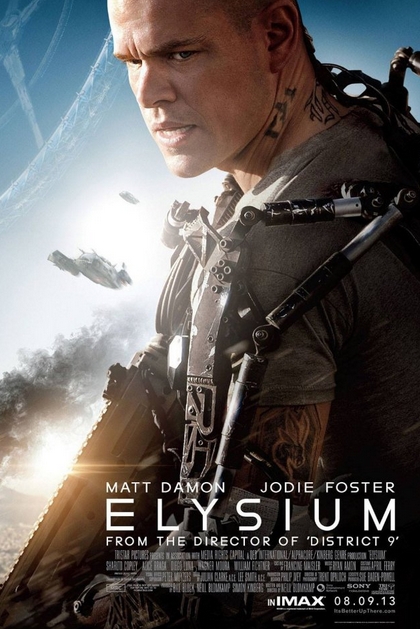
ELYSIUM


Rated R for strong bloody violence and language throughout

Cast: Matt Damon, Jodie Foster, Sharlto Copley, Alice Braga, Diego Luna, Wagner Moura, and William Fichtner
Written and Directed By: Neill Blomkamp


THE HAVES AND THE HAVE NOTS
Review By Andrew Shuster

Here’s a film that explores and denounces the injustices in the U.S. health care system, immigration, and social classes. What’s this, a new Michael Moore documentary? Nope… It’s the sci-fi summer blockbuster Elysium. Of course, this futuristic action movie probes these social and political issues through means of allegory; a strategy which the sci-fi genre is known for. Fortunately, writer/director Neill Blomkamp (District 9) is such a gifted storyteller that the heavy-handedness of his screenplay doesn’t prevent Elysium from being both wildly entertaining and one of the best sci-fi movies in a long time.

While District 9 used its extraterrestrial plot to cover the horrors of apartheid, Elysium goes even further with its socioeconomic criticisms. It’s commendable that Blomkamp strives to be socially responsible while delivering hard-hitting entertainment. The movie harkens back the futuristic thrillers of the 80's. In the same vein as the post- apocalyptic Mad Max, most of the Earthlings in this film are heavily tattooed and look like the attendees of a punk rock concert. As with Robocop, Matt Damon’s character's human body is transformed into somewhat of a machine, with a mechanical suit of armor power drilled into his exoskeleton. Throw in a little bit of Total Recall (the original) for good measure, and you’ve got a movie that isn’t wholly original, but completely satisfying nonetheless.
The year is 2154, and two classes of people exist. The wealthy (the 1%) live on an advanced space station orbiting above Earth known as Elysium. There is no war, disease, or poverty, and all of its denizens live in luxurious mansions. The rest of the population (the 99%) lives in the ravaged wasteland that is now known as Earth, with every city consisting of slums. The film is set in Los Angeles, which now appears to be entirely made up of Latinos plus Matt Damon. Damon plays Max, a former orphan with dreams of one day making enough money to buy a ticket to Elysium. Due to an accident at his factory job, Max is exposed to a lethal amount of radiation and given only five days to live. Seeing as every home on Elysium is stocked with a machine that can cure all diseases and heal all damage to the human body (because the rich have access to the best healthcare), Max is determined to get to Elysium and save himself.

Jodie Foster gives an odd and hammy performance as the ruthless Delacourt. First off, the origin of her accent is inscrutable. Her inflection is a little South African and a little British, often jumping back and forth between the two. Her character is responsible for preventing Earth citizens (immigrants) from illegally entering Elysium. She does this by employing a mercenary named Kruger (Sharlto Copley), who is positioned on Earth and shoots rockets at the unidentified spaceships, no questions asked. Speaking of Copley, he’s the highlight of the movie as the sadistic madman Kruger. Copley is so different from the inane hero whom he played in District 9 that I didn’t recognize him at first. He dons a Grizzly Adams beard and put on a bunch of muscle mass to play this remorseless killing machine.
Elysium features some of the most inventive and exciting action sequences in a long time. Blomkamp has conceived futuristic weapons that add a lot to the ingenuity of the battles. He also utilizes police cyborgs that look as if they could be the robotic cousins of the prawns in District 9. One of the best things about the action sequences is that they’re all story driven, with nothing is gratuitously thrown in to meet a summer blockbuster quota. The first real action set-piece doesn’t occur until about 45 minutes into the movie, and it’s a showstopper well worth the wait. The last third of the film is more action-heavy, with an inevitable mano-a-mano between Damon and Copley which you’ll be looking forward to the whole movie.

Credit is due to Sony Pictures for allowing Blomkamp to realize his dark vision with a necessary R-rating, a classification not typically acceptable for movies with a $115 million budget. But seeing as other summer blockbusters such as Man of Steel and The Lone Ranger came with a price tag of $225 million and $215 million, respectively, we’re living in a time where $100 million budgets are considered relatively cheap. Blomkamp has a thing for making heads and bodies explode, with at least half a dozen characters meeting their demise in such a manner. The film is set in a grim, ugly, and violent world, so a watered down PG-13 rating would have rang false. For fans of some good old-fashioned gore, you’ll get quite a few ‘money shots’.
For lack of a better term, most of Elysium is pretty ‘badass’. Blomkamp doesn’t quite reach the full potential of his ambitious idea (we don’t learn a whole lot about the inner-workings of Elysium), but the material here is much smarter than in your average sci-fi thriller. As with the Bourne franchise, Damon proves once again to be a formidable action hero, while Blomkamp demonstrates that he’s no fluke. Between District 9 and now Elysium, I can’t wait to see what sci-fi boundaries he crosses next.

Sunday, August 11, 2013

PRINCE AVALANCHE

* * ½ 

Rated R for some sexual content

Cast: Paul Rudd, Emile Hirsch, Lance LeGault, Joyce Payne, and Lynn Shelton
Written and Directed By: David Gordon Green


FOREST OF SOLITUDE
Review By Andrew Shuster

It’s hard to tell if Prince Avalanche is sort of tedious or sort of fascinating. As far as character studies go, there’s a lot to take in and analyze here. Performance wise, Paul Rudd is as good as he’s ever been; Emile Hirsch is better than he’s ever been. But perhaps part of the reason that the film never really takes off is that it just all feels so slight.

David Gordon Green directs, and adapted the screenplay from the Icelandic film Either Way. Set in the summer of 1988, the film revolves around highway workers Alvin (Paul Rudd) and Lance (Emile Hirsch), mundanely painting road surface markings. They bicker and bond, musing about life and the women they left behind. At it’s core, this is a film about loneliness. Alvin spends the entire summer in his ‘forest of solitude’, isolating from his city life and his girlfriend Madison (Lynn Shelton, in phone voice only), whom also happens to be Lance’s sister. Lance is discontented with his ‘on the road’ life; his only company being the mellow Alvin who often prefers to enjoy the silence than listen to Lance opine on life and love. Lance goes back to the city on weekends to hook up with girls; stories of which he brings back to Alvin, but we can’t help but get the idea that his accounts are embellished if not flat out fabricated.
Director David Gordon Green has been behind the camera of such raucous comedies as Pineapple Express with Seth Rogen, Your Highness with Danny McBride, and The Sitter with Jonah Hill. Despite the appearance of another Judd Apatow regular in Paul Rudd, do not expect anything like those rowdy mainstream comedies. When Green isn’t making stoner comedies, his other forte is in quiet, low-budget character examinations such as George Washington and All the Real Girls. This is very much in the same vein of the latter.

This movie is all about the performances. Rudd once again exhibits a sardonic wit and acerbic tongue, only unlike his personality in conventional comedies, this time his attitude is masking an underlying sadness. It’s suggested that Alvin is on anti-depressants and that his desire to sequester himself in the woods isn’t so much out of relaxation as it is his fear of embracing life. Hirsch plays Lance as cocky but also sweet and naive; with his traits also serving to hide his insecurities. The two mismatched men will begin to form a bond after their initial personality clash. But make no mistake, this is not done in any kind of traditional buddy-comedy manner.
One of the best aspects of the film is the dialogue, which is often amusingly insightful and touching. The movie comes off as if it was adapted from a stage play, talk wise; not so much with the road trip like setting. Alvin and Lance spend much of the film arguing but also opening up to one another. Regarding Lance and his sister, Alvin says, “This family, you are a weak people! You are a weak, feeble, flimsy, tenuous people!” He’ll later ask “How did you live your life up to this point without knowing how to gut a fish, or build a tent or tie a knot, or mind your own business?” It’s this kind of quirky banter that both emotionally resonates and makes up the best portions of the film.

I dare not ruin it, but there’s a bizarre and enigmatic twist ending like something out of an M. Night Shyamalan movie that adds a whole other level to what you will take away from the film. If my personal interpretation is accurate, the conclusion is quite intriguing and completely unexpected from a movie of this manner.
Prince Avalanche is a minimalist film that was secretly shot in only 16 days. Whatever the direct opposite of an epic would be, this is it. There’s a lot to appreciate about this movie, but unfortunately some of it is also fairly boring. It’s certainly interesting, different and an experiment in style. It’s the type of movie that is so disconcerting on a first time viewing, that I might re-watch it down the road and realize I absolutely love it. But as for now, and as far as cinema goes; this is more of an art project than it is a full-fleshed film.

Wednesday, August 7, 2013

WE'RE THE MILLERS


Rated R for crude sexual content, pervasive language, drug material and brief graphic nudity

Cast: Jennifer Aniston, Jason Sudeikis, Emma Roberts, Will Poulter, Nick Offerman, Kathryn Hahn, with Luis Guzman, and Ed Helms

Written By: Bob Fisher, Steve Faber, Sean Anders, and John Morris
Directed By: Rawson Marshall Thurber

MILLER HIGH LIFE
Review By Andrew Shuster

A more apt title for We’re the Millers would be National Lampoon’s Marijuana Vacation. Only this isn’t really a stoner comedy at all. It’s a family comedy disguised as a stoner comedy. At that, an R-rated family comedy that’s certainly not ‘for the whole family’, unless you’re quite the irreverent, dysfunctional bunch. For a movie about a pot dealer who enlists a fake family to help him smuggle a large shipment of weed across the U.S./Mexico border, no one so much as lights up a joint throughout the entire film. Instead we get a surprising amount of heart that pushes family values, mixed with the usual array of crude sexual humor. The movie plays like a never-made sequel to Chevy Chase’s Vacation series, but with a contemporary edge that we’ve come to expect from the current trend of R-rated comedies.

Saturday Night Live alum Jason Sudeikis gets his first go at leading man after a string of scene-stealing supporting roles in films such as Horrible Bosses and Hall Pass. If this movie is any indication, Sudeikis could very well be one of the lucky SNL’ers to parlay his TV gig into a major motion picture career; he shares that snarky, yet goodhearted quality that Bill Murray and Chevy Chase had. Although Sudeikis is the lead here, he has to settle for second billing to America’s sweetheart Jennifer Aniston. In addition to being a tabloid magnet, Aniston’s proving to be a very funny comedic performer. Between this movie and last year’s Wanderlust, it’s refreshing to see an A-list actress choose edgy and offbeat material in lieu of generic ‘boy meets girl‘ romantic comedies (not that she hasn’t done a few of those). Like Sudeikis, Aniston had her own scene-stealing turn in Horrible Bosses (though the two never shared screen time together).
Sudeikis plays David Clark, a slacker pot dealer whose been living the same lifestyle since college. When thousands of dollars and pounds of pot are stolen from his apartment, David's employer and ‘white collar’ drug kingpin Brad Gurdlinger (Ed Helms) forces him to pick up a huge shipment of weed from a Mexican drug cartel in order to make good on his debt. Realizing that a scruffy looking hipster crossing borders could be a red flag, David enlists the help of a stripper (Aniston), a teenage runaway (Emma Roberts), and his dorky young neighbor (Will Poulter), to pose as a clean-cut all-American family traveling cross country in an RV. Obviously, this plan will not go so smoothly, and hilarity and hijinks will ensue.

If at times the film may feel like an R-rated sitcom, that’s not to say it isn’t funny. Integrating the ‘comedy of errors’, ‘mistaken identity’, and ‘fish-out-of-water’ scenarios, this is a ‘high-concept’ (no pun intended) comedy that has little in common with reality (middle-aged strippers do not look like Jennifer Aniston). Although the screenplay is credited to four writers, Bob Fisher & Steve Faber (the duo behind Wedding Crashers), and Sean Anders & John Morris (the duo behind Hot Tub Time Machine), luckily the story moves with fluidity and doesn’t have that ‘movie by committee’ feel. While there are many set-pieces thrown in that feel like ideas tossed out at pitch-meetings, the comedy (both in setup and execution) is done so well that the somewhat contrived nature of it hardly matters. The first act is probably the weakest portion of the film, but once the ‘family’ hits the road, the movie hits its stride; with director Rawson Marshall Thurber (Dodgeball: A True Underdog Story) keeping a fun pace up until the closing credits.
To a large extent, the success of this film lies on the likability of the actors. Sudeikis and Aniston are strong leads who anchor a fantastic supporting cast. Will Poulter, a relatively unknown British actor, is a real find as the awkward, sweet Kenny. The scene where his “sister” and “mom” teach him how to kiss is perhaps the funniest thing in the movie. Not only will Poulter be the envy of every guy in the audience with his gratuitous make out scene, but the payoff to this joke is ingenious. Nick Offerman and Kathryn Hahn bring the laughs as The Fitzgerald’s, a real-life version of the happy-go-lucky middle American family that 'The Millers' are only pretending to be. But as you’ll see, The Fitzgerald’s have a naughty side. During their travels, 'The Millers' will cross paths with DEA agents, drug lords, and kooky midwesterners, learning lessons along the way. Not only is it all very funny, but you’ll root for these outcasts as they begin to bond and form their makeshift family.

With a couple of exceptions, 2013 hasn’t delivered much in the laughs department. So while We’re the Millers isn’t necessarily side-splitting, it’s just gut-busting enough to make it one of the best comedies of the year. The storyline is entertaining, the cast is endearing, and even if it isn’t always hilarious; it is always fun. The script is full of witty plot points (including a sly ending) making for a more clever farce than you might expect. They’re raunchy, they’re sweet, and they’ll make you laugh; so go on vacation with ‘The Miller’ family.